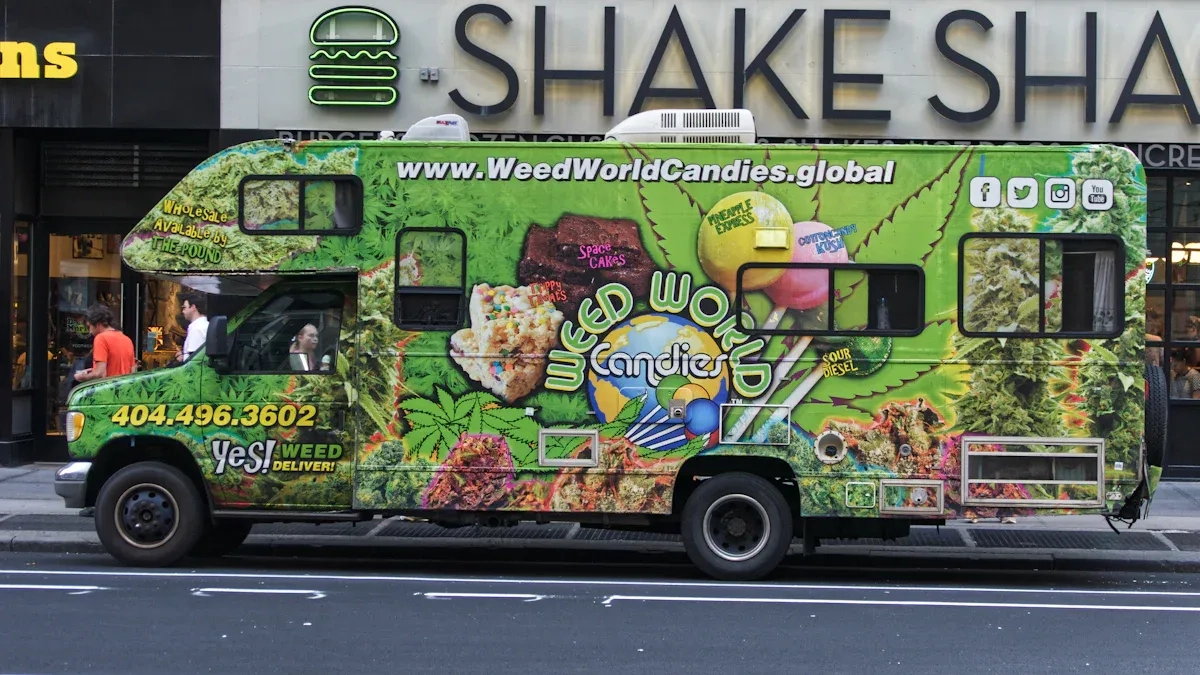
Your truck acts as a powerful, mobile advertisement. A single vehicle wrap can generate 30,000 to 70,000 impressions daily. Effective truck wraps designs are crucial. They cut through visual clutter and make lasting impressions. How can you ensure your truck wrap isn't just seen, but remembered and acted upon?
Key Takeaways
- Keep your truck wrap design simple and clear. Focus on one main message, use large, easy-to-read fonts, and include clear contact information.
- Use strong colors that stand out and make your message easy to see. High contrast helps people read your text quickly, even when your truck is moving.
- Make sure your call to action is clear. Tell people exactly what you want them to do, like 'Call Now' or 'Visit Our Website,' and make it easy to find.
Foundational Principles for Truck Wraps Designs
Effective commercial truck wraps designs should be simple. Think of each side of your vehicle as a billboard, not a brochure. You have only a few seconds to make an impression. This means your design must be clear and impactful.
Defining Audience and Brand Identity
You must first understand your target audience. Consider their demographics, interests, and preferences. This helps your design truly resonate with them. Think about if your customers are local or spread across a larger area. Tailoring your design to this audience increases engagement.
Your brand identity also needs clear visual representation. Choose a consistent color scheme. Colors can improve brand recognition by up to 80%. Decide if a symbolic logo, like a company icon, or a literal logo, showing what you do, best represents your brand. Ensure visual consistency across all your marketing materials. This builds a strong, recognizable brand image.
Crafting Clear Messaging
Your truck wrap needs a clear, concise message. Focus on one main idea. Include your brand name, logo, and a key service you offer. Avoid putting too much text on the wrap. Potential customers only see your truck for a few seconds.
Use large, legible fonts. Small or complicated fonts are hard to read quickly. Make sure your images are high-quality and authentic. Avoid pixelated or generic stock photos. They look unprofessional. Always include clear, actionable contact information. A website address or a large phone number encourages immediate customer engagement.
Core Design Principles for Truck Wraps
You want your truck wrap to grab attention and deliver your message effectively. This requires careful planning and adherence to core design principles. Think of your vehicle as a moving canvas. You need to keep the design simple, focus on one clear message, and use high-contrast colors. Consistency is key. Avoid common mistakes like too much text, small fonts, or busy designs. Instead, use bold, consistent colors, clear typography, and high-resolution imagery.
Strategic Color and Contrast
Color is the first element your audience processes. It communicates with potential customers before text or images. Color psychology shows how different wavelengths of light affect human behavior. Up to 90% of snap judgments about products rely solely on color. Consistent color usage can boost brand recognition by up to 80%.
High-contrast color combinations ensure maximum visibility. Your wrap needs to be seen at various distances and in different lighting. Research from 3M shows that contrast between text and background colors can improve readability by up to 40%. Effective high-contrast pairings include black text on a yellow background, which offers the highest readability from a distance. White text on a blue background provides strong readability with a professional look. Yellow text on a black background offers excellent nighttime visibility. Simple, high-contrast designs with limited color palettes generally outperform complex, multi-colored wraps. They help people retain your message and recognize your brand better.
Complementary colors create vibrant, attention-grabbing combinations. You can make your vehicle wraps stand out. Use them strategically to avoid overwhelming your audience. For example, you can use complementary colors for different elements, like a blue vehicle base with orange accents. You can also create separation with neutral buffers or use them at different saturation levels. A 2023 study by Avery Dennison found that vehicle wraps using strategically placed complementary colors received 27% more attention from pedestrians and drivers.
Consider the psychological impact of colors. Red evokes excitement and urgency. Fast-food chains often use it to stimulate appetite. Blue suggests trust and dependability. Financial institutions use it to communicate reliability. Green symbolizes nature and health. Eco-friendly brands frequently use it. Yellow generates happiness and optimism. Delivery services use it to appear friendly. Black conveys sophistication, while white suggests simplicity. Luxury brands often combine them. Purple implies creativity and luxury. Beauty brands use it for a pampering experience. A Houston-based plumbing company saw a 34% increase in call volume after switching to a blue and yellow wrapped fleet. A local food delivery service experienced a 28% increase in new customer acquisition after changing their wraps to red and yellow. Remember, color meanings vary across cultures. Research local color associations to avoid negative connotations.
Typography for Readability
Your text must be easy to read, even when your truck is moving. Choose bold, sans-serif fonts for maximum readability. These fonts lack decorative strokes, preventing blurring at a distance. Bolding text enhances legibility and directs viewer attention. Helvetica, Futura, and Arial are effective sans-serif font examples.
Follow the '1-inch per 10-feet rule' for font sizing. For every 10 feet of viewing distance, letters should be at least 1 inch tall. For instance, text viewed from 100 feet away requires letters at least 10 inches high.
Avoid common legibility issues. Your vehicle is three-dimensional. Do not place text or logos near areas that might distort or cut off the graphic, such as doors, handles, or curves. Use clear, legible fonts. Sans-serif fonts are recommended. Avoid script fonts. Do not use too much text. Limit your message to critical details like your brand name, tagline, services, contact info, and call to action. Avoid fine print. Larger text is always better for readability from a distance. Do not overcrowd your design with too many colors or loud patterns. Simplistic designs allow elements to 'pop'.
High-Quality Imagery Integration
High-quality images and graphics enhance your wrap’s visual appeal. Use sharp, high-resolution files to avoid pixelation. If you use photos, ensure they are relevant to your brand and convey your message effectively. A catering company, for example, could feature an image of their most popular dish.
Eye-catching visuals can significantly enhance the overall visual impact of your fleet wrap. Select visuals that complement your brand story and engage your target audience. High-resolution images are essential for a crisp, professional-looking wrap. Vehicle graphics are especially large. You need high-resolution images that will still look crisp when expanded. The ideal resolution is 300 dots per inch (DPI). A DPI in the range of 100-150 is still adequate, especially for viewing from a distance.
Layout for Visual Flow
Visual hierarchy is essential. It guides your audience's eyes through your message. This helps them quickly grasp key information and maximizes your campaign's impact. The logo or business name should be the largest element. It needs to be readable from 20-30 feet. Secondary elements, like descriptors, should be about half the size. They clarify your service. Tertiary elements, such as contact information, should be smaller but still legible from 10-15 feet. Often, you can use bold or high-contrast colors for these.
High-contrast color pairings ensure text stands out. This is true even in challenging conditions. Accent colors can draw attention to calls-to-action, like a bright red phone number. Utilize a “Z” or “F” pattern for eye movement. For horizontal panels, place your logo in the upper front, a descriptor in the center, and contact information in the lower rear. Avoid placing critical text in areas like door jambs or below rocker panels. People are less likely to look there. Directional cues like arrows can guide the viewer's gaze towards a call to action.
Balance imagery and text. Combine textual elements with relevant and captivating visuals. This tells a story or emphasizes your message. Strategic use of negative space, or whitespace, improves legibility. It emphasizes key information and contributes to a visually appealing design. Identify the focal point on your vehicle. This is the area that captures the most attention. Ensure no single element overpowers others. This creates a visually pleasing design. The Rule of Thirds suggests dividing your graphic into thirds. Place primary elements in one-third to draw the human eye into the composition.
Avoid common layout mistakes in truck wraps designs. Do not use small text, complex fonts, or cluttered layouts. These make your message hard to read when your vehicle is in motion. Prioritize bold, easy-to-read fonts. Limit text to essential information. Do not use low-quality images. They appear blurry or pixelated when enlarged. This diminishes your professional look. Always use high-resolution images and vector graphics. Do not choose the wrong colors. Lack of contrast or colors that do not align with your brand can confuse viewers. Use high-contrast combinations and stick to your brand colors. Do not overlook vehicle features. Placing critical information over windows, handles, or seams can distort your design. Design with vehicle contours in mind. Avoid placing key elements over features. Overcrowded visuals, unclear messaging, and color clashes also hinder visual flow.
Technical Aspects of Truck Wrap Application
Vehicle Measurement and Templates
Accurate measurements are crucial for successful truck wraps designs. You must take "head-on" photos from the sides and rear. Ensure the photo's plane is parallel to the vehicle. This avoids skewing the shape. The entire vehicle must be in the frame. Do not crop wheels or take partial views. Measure the height and length of each area you want to cover. Remember, roofs and bumpers need extra material.
You should assess the vehicle's body for dents or rust. These can affect wrap longevity. Pay attention to body trim, door handles, and gas caps. Avoid placing important design elements over them. Remove detachable emblems to prevent wrap damage. Consider bumpers; some are hard to wrap. Rivets on box trucks need premium vinyl and extra installation steps.
Use essential measuring tools. These include flexible tape, digital calipers, and a calculator. Measure every panel individually. Record all measurements accurately. Add 5-10% extra material for tricky spots. For complex curves, ensure contour mapping for full coverage.
Vehicle-specific templates are also vital. They provide a scaled view of your truck from different angles. This allows for precise placement of design elements. Templates ensure an accurate fit and alignment. They save time and reduce errors during installation.
Material Selection and Durability
Choosing the right material ensures your wrap lasts. High-quality vinyl offers better durability and flexibility. It resists wear and tear. Premium materials, like Ravoony Plus Gloss Metallic Vampire Red Vinyl Car Wrap, a metallic wrap, have a glass-smooth finish. This eliminates the "orange peel" effect. They also offer better stretch for professional installation.
Key factors affect longevity. UV protection prevents fading from sunlight. Garage storage protects wraps from weather. Proper cleaning with pH-balanced cleaners preserves durability. Professional installation prevents peeling and bubbling. Extreme temperatures can cause vinyl to expand or shrink. This leads to cracks. High-quality wraps withstand extreme weather and UV exposure. They maintain appearance and functionality over time.
Pre-Press and File Preparation
Proper file preparation prevents printing issues. Use CMYK color mode. Monitors use RGB, but printers use CMYK. Converting early prevents color shifts. For images, use TIFF, PSD, or maximum-quality JPEG files. For final artwork, PDF/X-3 or PDF/X-4 are preferred. Use proper color profiles for images. Also, use ICC profiles from your printer for specialized materials. This ensures color consistency.
Avoid common errors. Do not rely only on digital vehicle templates. They might not show minor vehicle changes. Cross-reference templates with actual vehicle images and measurements. Insufficient curing time for inks is another issue. Solvent inks need 24-48 hours to cure before lamination. Rushing this traps solvents. This degrades the adhesive and damages the film. It can lead to wrap failure. Highly saturated colors need more curing time.
Strategic design transforms your truck into a powerful, mobile marketing asset. You learned about foundational planning, mastering design elements, technical requirements, and best practices. Invest in professional design and installation. Your wrap will look great and drive business goals. Well-designed vehicle advertising offers enduring power.
0 Comments